/
Agencies
Agency Pricing Guide: How to Price Your Services in 2025

Your last project just wrapped. The client is happy. But when you calculate the actual profit, something feels off.
You charged $10,000. After salaries, software, and "quick" client emails, your margin is a thin 12%. You kept $1,200 instead of the $3,000 you expected.
Why are you working this hard but barely making a profit? According to HubSpot’s survey of 782 agencies, only 30% of agencies ever break the $1M revenue mark. Most stay small because they price for survival, not scale. They let admin work and unbilled changes eat their margins alive.
You will learn to calculate rates that protect your margins, understand which pricing model fits your agency, and price services that keep you profitable as you grow.
The Hidden Costs Killing Your Margins

Most agencies know their obvious costs. Salaries, office space, computers. But hidden costs destroy profitability. Here's what you are probably missing:
The 'Franken-stack' Tax: Why Separate Tools Kill Margins
Many agencies rely on separate tools for project management, time tracking, invoicing, and communication. This “Franken-stack” often costs $300–$500 per month for a small team:
Project management: $10 to $15 per user
Time tracking: $10 per user
Invoicing software: $15 to $30 monthly
Communication tools: $8 per user
File storage: $12 to $20 monthly
Administrative Overhead: 20% to 30% of total time
Status update emails
Client communication
Invoice creation and follow-up
Internal meetings
Proposal writing
Sales and Marketing: 15% to 25% of revenue
Website and content
Paid advertising
Networking and events
Sales calls and demos
If you are not factoring these into your pricing, every project loses money. Your hourly rate might be $150, but your actual cost is $180. Right?
To fix this, you need to choose the right pricing model for how your agency actually works.
Understanding Agency Pricing Models
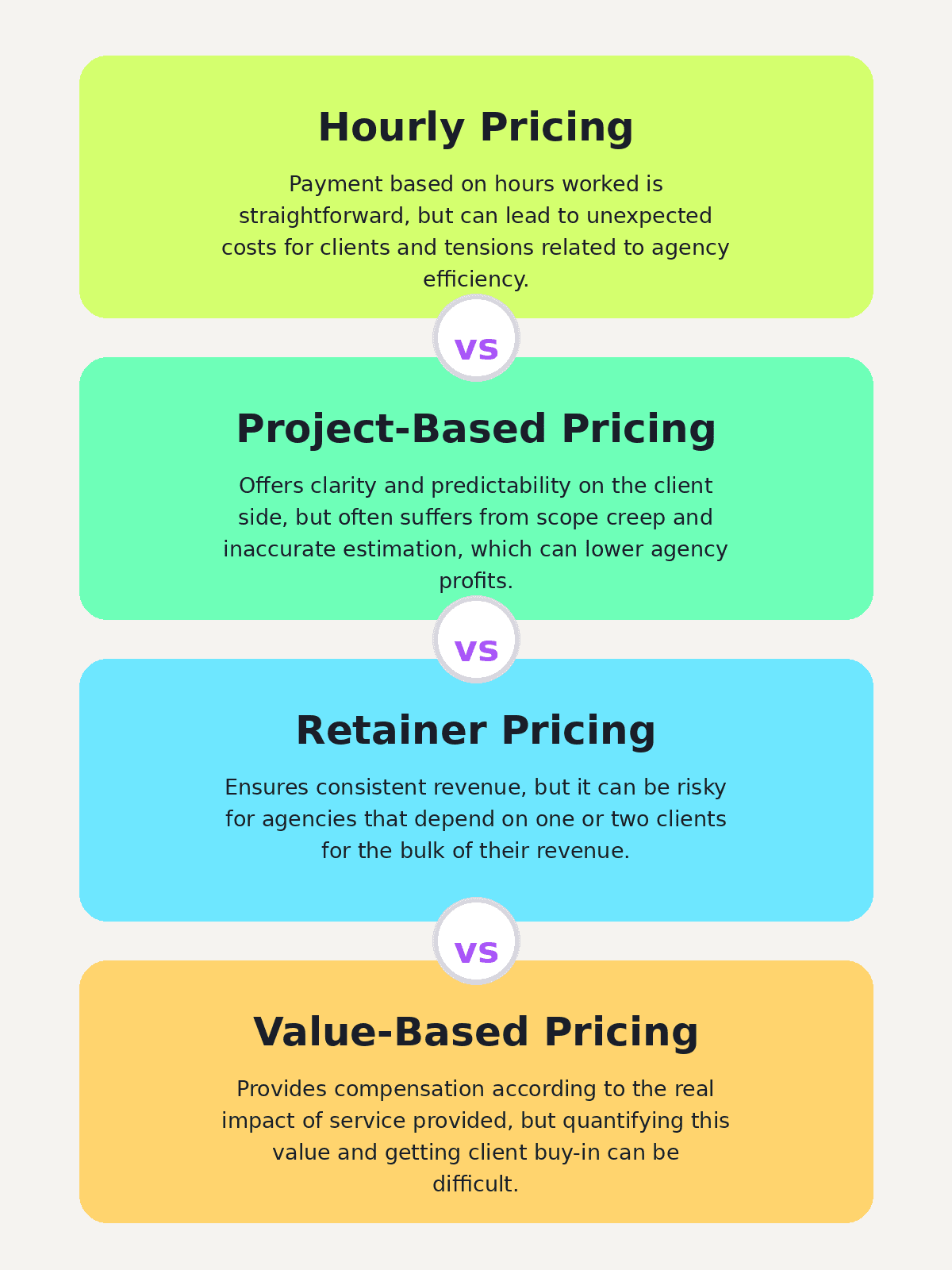
You have four main options. Each works for different situations.
1. Hourly Pricing
You charge for every hour worked. Simple, but can be limiting.
When it works:
Discovery phases with unclear scope
Small, unpredictable projects
New agencies building their portfolio
Typical rates: $75 to $250 per hour
The benefit: Flexible, easy to calculate, and you get paid for all hours worked
Challenge: Efficiency penalizes your earnings, the faster you complete work, the less you earn; clients may question every logged hour
2. Project-Based Pricing
You charge a fixed fee for clearly defined deliverables. Most agencies prefer this model.
When it works:
Clear scope and deliverables
Repeatable internal processes
Fixed timeline projects
Typical range: $5,000 to $50,000+, depending on complexity
The benefit: Clients get cost certainty; efficiency increases profit; better clients prefer fixed pricing
Challenge: Scope creep can erode margins. Always define deliverables clearly upfront
3. Retainer Pricing
Clients pay a recurring monthly fee for ongoing access to your services.
When it works:
Long-term client relationships
Ongoing support, maintenance, or optimization
Predictable monthly deliverables
Typical range: $3,000 to $10,000 per month
Average retainer (2025): $3,209 per month
The benefit: Predictable revenue, easier cash flow planning, stronger client relationships
Challenge: Requires a consistent pipeline, losing even one client can hurt planned revenue
4. Value-Based Pricing
You charge based on outcomes delivered, not hours worked.
When it works:
Measurable business outcomes
Strategic or advisory consulting
Established agencies with proven results
Typical range: 10% to 30% of the value created
The benefit: High profit potential; aligns incentives with clients; rewards outcomes rather than effort
Challenge: Requires confident positioning and strong trust; clients must believe in your ability to deliver results
Quick Comparison
Pricing Model | Predictability | Profit Potential | Client Preference |
|---|---|---|---|
Hourly | Low | Low-Medium | Mixed |
Project | Medium | Medium-High | High |
Retainer | High | Medium | High |
Value-Based | Medium | Highest | Low-Medium |
Most successful agencies use combinations. Hourly for discovery. Project-based for delivery. Retainer for ongoing support.
How to Calculate Your Hourly Rate
Even if you charge per project, you need to know your hourly cost. This determines whether your quotes are profitable.
The Formula
(Annual Salary + Overhead) × Markup ÷ Billable Hours = Hourly Rate
Real Example: Developer on Your Team

Step 1: Base Salary
Annual salary: $80,000
Step 2: Calculate Overhead (40% multiplier)
Payroll taxes and benefits: $20,000 to $24,000
Software and tools: $3,600 annually
Equipment and setup: $2,400 annually
Insurance and legal: $1,500 annually
Total overhead: $32,000
Total cost before profit: $112,000
Step 3: Apply Markup for Profit
Most agencies use 2x to 4x multipliers. The Conservative approach uses 2.5x.
$112,000 × 2.5 = $280,000 target revenue per developer
Step 4: Calculate Billable Hours
Your developer works 2,080 hours annually (40 hours × 52 weeks). But they're not 100% billable.
Realistic activities:
Team meetings: 10% of time
Admin work: 10% of time
Vacation and sick days: 5% of time
Training and development: 5% of time
Billable utilization: 75% is realistic, 80% is aggressive
2,080 hours × 0.75 = 1,560 billable hours
Your Minimum Rate: $280,000 ÷ 1,560 = $179/hour
Round up for simplicity: $185 to $200/hour
How to Build Your Pricing Strategy?

Healthy pricing isn’t guesswork. It’s a series of deliberate decisions.
1. Choose your market position
Premium:
Higher prices
Fewer clients
Strong margins
Competitive (most agencies):
Market-aligned pricing
Strong processes
Industry specialization
Competing primarily on price creates fragile businesses.
2. Quantify client value
Pricing strengthens when value is clear:
A 2% conversion lift may mean $100k in new revenue
A product launch may unlock a new revenue stream
A campaign may generate a $200k sales pipeline
Value anchors pricing better than hours ever will.
3. Understand your cost structure
Fixed costs: salaries, tools, insurance
Variable costs: contractors, licenses, infrastructure
High fixed costs require consistency. High variable costs reduce risk but pressure margins.
4. Set margin targets
Average agencies: 15–20%
High performers: 25–35%
Set your margin goal first, then work backward to pricing.
Current Market Rates by Agency Type
Here's what agencies actually charge in 2025.
Agency Type | Hourly Rate | Project Range | Monthly Retainer |
|---|---|---|---|
Web Design | $100–$175 | $8k–$100k+ | $3k–$8k |
Mobile App | $125–$200 | $25k–$250k+ | $5k–$15k |
Digital Marketing | $75–$150 | $3k–$30k | $2.5k–$10k |
Software Development | $150–$250 | $50k–$500k+ | $10k–$30k |
“According to the 2025 Agency Benchmark Report by Agency analytics , average retainers across digital agencies rose 8% YoY, driven by software cost increases and talent competition and top 10% of agencies operate at 30–35% net profit margins.
Pricing Mistakes That Cost You Money

1. Underpricing to Win Clients
Low prices attract the wrong clients and lock you into weak margins. It’s hard to raise rates later, and quality suffers.
Fix: Start at market rates. Sell value, not discounts.
2. Incomplete Cost Math
Many agencies price using visible costs only. The rest quietly eats into profit.
Fix: Base pricing on the true cost of delivering work.
3. Treating Internal Time as Free
Meetings, coordination, and client communication still cost money even if they’re not billable.
Fix: Price assuming realistic billable time, not perfect utilization.
4. Never Raising Prices
Costs go up every year. Prices often don’t.
Fix: Review rates regularly and adjust as your costs and value increase.
The Silent Profit Killer: Revenue Leakage
Most agencies don’t lose money because their pricing strategy is wrong.
They lose money after the strategy is set, when work isn’t fully captured.
Revenue leakage happens in delivery: calls that run long, Slack threads that turn into production work, and PM time spent managing scope instead of logging it. These hours never make it to the invoice, quietly eroding margins.
When pricing seems reasonable but profits still fall short, the problem isn’t the model.
It’s missing or incomplete delivery data.
Tools That Support Better Pricing
Accurate pricing depends on accurate delivery data.
If you don’t know how long work actually takes, pricing becomes guesswork, even with a sound strategy.
Most agencies lose track of data because they rely on multiple disconnected systems:
Asana or Monday for projects
Harvest or Toggl for time tracking
QuickBooks or FreshBooks for invoicing
This creates three challenges:
Team members resist logging time in multiple tools, making data unreliable
Multiple subscriptions increase costs and fragment information
Manual transfer of hours wastes time and causes missed billing
Time Tracking Is Non-Negotiable
Tracking time consistently shows which projects are profitable, which clients consume excessive effort, and which hours are going unbilled. Without it, even the best pricing model fails to capture true profit.
Integrated Solutions Save Money and Time
Your profitability improves when tools work together.
What integration does:
Time tracking feeds directly into invoicing
No manual data entry or copying
Project management includes client portals
Status update emails drop by 80%
The cost difference matters:
Traditional approach (separate tools):
Monday : $12/user/month × 10 = $120
Harvest: $10/user/month × 10 = $100
QuickBooks: $30/month
Total: $250/month or $3,000/year
Integrated platform approach:

Total: $1,188/year
Difference: $1,812 annually
For that 10-person agency, this saves $181 per person annually and 150 to 250 billable hours, equivalent to $22,500–$37,500 in recovered revenue.
When time, work, client communication, and invoicing are connected, agencies can see true project costs, making pricing accurate instead of assumed.
Note: Pricing and tool comparisons are based on public data available as of 2025. Always verify current pricing before finalizing budgets.
Frequently Asked Questions (FAQ's)
1. How do I calculate my agency's hourly rate?
Use this formula: (Salary + Overhead) × Markup ÷ Billable Hours
Example: ($80,000 + $32,000) × 2.5 ÷ 1,560 hours = $179/hour minimum
2. Which pricing model works best for tech agencies?
Most tech agencies succeed with project-based pricing for defined deliverables. Use retainers for ongoing relationships. Reserve hourly pricing for discovery phases only.
3. How often should I raise my prices?
Review pricing every six months. Raise prices annually at a minimum. Increase rates when costs change by 10% or more. Raise prices for new clients every 12 to 18 months.
4. Should I charge hourly or per project?
Project-based pricing works better when you have predictable processes and clear deliverables. It rewards efficiency and gives clients cost certainty. Use hourly only when the scope is unclear.
5. How do I justify higher prices to clients?
Focus on value delivered, not hours spent. Show ROI through case studies. Demonstrate your process and expertise. Position against results, not against competitor rates.
Start Pricing for Real Profitability
Your pricing strategy determines whether your agency thrives or struggles. Underpricing doesn't just hurt this quarter. It attracts demanding clients, burns out your team, and prevents investment in growth.
Action steps:
Calculate your true hourly cost, including all overhead
Apply a 2.5x to 3x markup for healthy margins
Compare your result to market rates for your services
Choose a pricing model that fits your delivery process
Review and adjust pricing every six months
Stop leaving money on the table. Start with the hourly rate calculation. You'll likely discover you're charging 20% to 40% below what you need for sustainable profitability.
What's your current effective hourly rate? Calculate it now and see if it supports your target margins.